F.J. Norman was a pioneer of the modern Japanese martial arts who introduced kendo to audiences outside Japan. Apart from writing about the martial culture of Japan, his actual skill in kendo earned him considerable respect from Japanese and Westerners alike. Upon discovering his 1905 book The Fighting Man of Japan: The Training and Exercises of the Samurai (Archibald Constable & Co, London, 1905),
There is a comprehensive paper on F J Norman by Alexander Bennett. A Western Academic working in Japan
Evidently, Norman was the proverbial ‘black sheep’ of a highly distinguished family, and his antics alienated him from many of his relatives. First, he left the army without leave and ventured to Japan where he taught at a number of prestigious colleges, and also undertook the study of kendo and other aspects of Japanese culture. He recorded his experiences in a way which makes for fascinating reading. After finally leaving Japan and going to England sometime after 1902, he married a woman whom his family did not approve of, again causing him to be the object of ostracism.
1855 Feb 23. Appears to be his actual date of birth in India. He put in his RIC enlistment 1862 Feb 22, born India. According to this service record, he was born on February 23, 1855 at Mooltan in India.
1876 Jun 6.Enlisted in 11th Hussars. He rises to Sgt by 9 Dec 1881, when he is commissioned. He was the son of Col Frank Norman of Bengal Staff Corps
1881 Dec 10 Gazetted 2nd Lt in 14th Hussars. WO 76/549, the records of services of officers of the 14th Hussars stationed at Secunderabad, Madras, 1826–1891. His full name was Francis James Norman, and he was gazetted a lieutenant in the 14th Hussars on December 10, 1881, after serving in the ranks for 5 years 187 days. The entry gives his date of birth as March 6, 1855, which is slightly at variance with the date quoted on his service record. No war service is indicated at the date of publication, and he probably did not see action as there is no reference to it on his service record either.
He could speak “Hindustani” (Urdu). His service in the ranks, was spent entirely in the 11th Hussars, and began on June 6, 1876, with the rank of private, finishing on December 9, 1881, as a sergeant, after which he received his commission in the 14th Hussars. From December 1877 to January 1882 he was based in Great Britain, thereafter serving in the East Indies until February 4, 1887, the day he left the regiment. His record is annotated “Superseded 4 Feb, 87”, but there is no information as to the manner of his departure (transfer, resignation, dismissal etc.). Under the column headed “Date of Half Pay” the abbreviation “appt.” appears. This could mean that he received another appointment so that half pay was inapplicable. He was not married at the time as the word “Single” appears very faintly in the space left for “Married or Single”.
1886 Dec 21. The Times announces that FJN is superseded for absence without leave, and FJN disappears from the subsequent army list of Jan-Mar 1887
1888 Moves to Japan. Within the text of his book he states “the summer of 1888 found me established in Tokyo…” A search of the “Japan Directory”, a comprehensive list of foreigners residing in Japan during the Meiji Period, shows his name for the first time in the 1889 edition. For the first three years he resided in the Kanto region and taught (presumably English) at the First Higher Middle School in Tokyo. From 1894, he is listed as living at Etajima in Hiroshima, the home of the Imperial Naval College. His name disappears from the records after 1899.
1905 His book published in London. The Fighting Man of Japan: The Training and Exercises of the Samurai (Archibald Constable & Co, London, 1905),
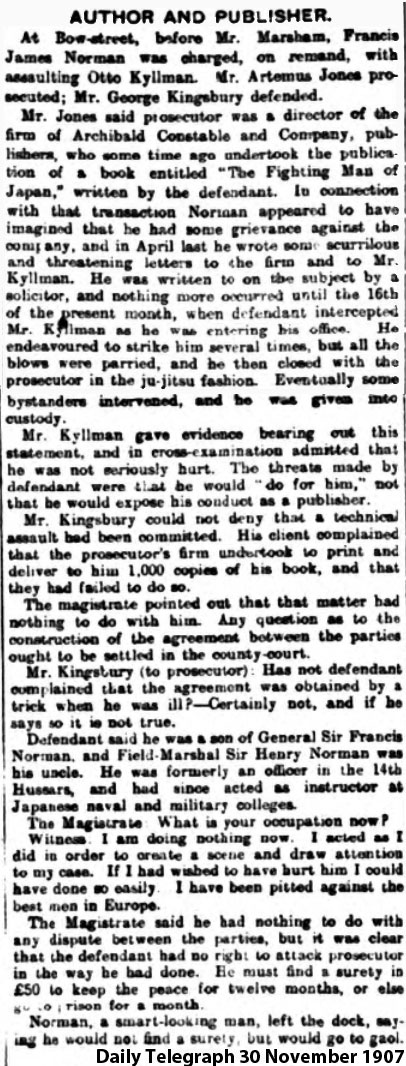
1907 Dec 30 Report of an altercation with the publisher of his book
1908 Feb 4. Married to Margaret Lily Gent in Kensington, London
1911 census at Paddington. London. He is a Journalist and Author who received a small allowance from his family

1916 Another book written by Norman that was published in Calcutta in 1916. The book titled Notes and a Report on the Kazusa System of Deep Boring for Water (Thacker, Spink & Co.)
1917 Jul. Starts service in the ‘New Armies’ (later the Labour Corps) as a 2nd Lieutenant in the Chinese Labour Corps. (This contradicts Bill’s indication that he was a linguist to Indian troops).
From my father [FJN’s second son] I know that as children they originally lived in Paddington, London. My father was a mischievous choirboy at St James church there. My grandfather [FJN] went to the First World War and was gassed in the trenches. He returned home to convalesce in Brighton and the family moved there, living in Kemp Town. The boys attended Brighton College
For reasons which nobody now knows, he decided to go to the front in the First World War. He would have been in nearly sixty years of age by then, which makes his decision surprising to say the least. It seems he was a victim of poisonous gas in the trenches, and was forced to return to England to spend the rest of his days in a nursing home in Brighton. Why would he want to go to war at his age? What did he hope achieve? Was it an attempt to retrieve some respect in family circles? Whatever the case, his wounds distanced him from his direct family also; with a young wife and three young sons, he had no means to provide for them.
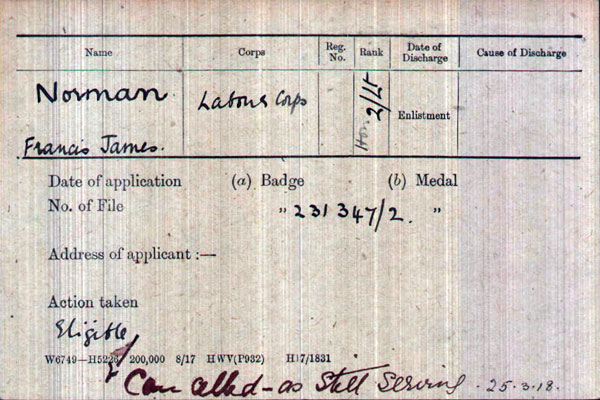
1918 Aug 25. Entered for a “Silver War Badge” generally awarded on being injured and invalided out, presumably because of mustard gas exposure. However, this was cancelled as he was still in service on this date
1920 May . Ends service as temporary Lieutenant in the Chinese Labour Corps
1920 Jul 10. Joined RIC as a Barrack Defence Sgt. There is nothing further in the RIC record to say what happened to him. He never got promoted to District Inspector
1926 Jun 3. Died in Brighton. . He died in an army nursing home and he is buried in a cemetery there. We did some research and found the plot where he is buried. Died from a lung condition acquired 8 years earlier during WWI, at the Red Cross Hospital on Marine Parade, or Percival Terrace. Previous address: 5 or 3 Arundel Street. Occupation according to death certificate: “Author and Journalist"
WO 372/15/3436