

The official British Army "Records of the Rebellion in Ireland" written in 1921 just after the Truce was signed
Abstract
The stereotype of the average Auxiliary as a drunken lout, released from a British gaol, in order to run riot in Ireland appears to have been little researched. Stories which were put out as "spin" by both sides at the time, have not been properly checked, and have been "cut and pasted" ever since on the basis that "everyone knows that....". Having researched the ADRIC in some depth, I would go along with the pronouncement by J C Reynolds , a T/Cadet who was an IRA spy and later joined the Irish Army, who said in notes that are included in Collins Papers, that among the the Auxiliaries "some were very good and about 10% were bad eggs" . The vast majority of the Auxiliaries were in the middle, and were men who had only become British officers because of the need for more officers as WW1 progressed. These men who joined the ADRIC were the sons of shopkeepers and tradesmen, and they needed a job post war. They were attracted by the money that the ADRIC offered
This analysis sets out to answer the question "Who were the Auxiliaries?". Most of the records of the Auxiliary Division of the Royal Irish Constabulary (ADRIC) were destroyed when the British left Ireland. What is available today boils down to two registers, one alphabetic and one numeric , which disagree on men's ADRIC service number in many cases, and even on essentials like initials or regiment. The handwriting is bad, and they are difficult to transcribe. These registers are available in the British National Archives (HO184) and they contain few other scraps of information on the ADRIC, but basically it comes down to the two registers. As the ADRIC's time in Ireland went on, the registers became scrappier and even less information was given on recruits. By the time the last 10% of recruits arrived in Ireland, it was virtually impossible to pinpoint who they were because of the paucity of information on them in the registers. So it is not surprising that it has been difficult to get a complete list of recruits to the ADRIC.
In additon there is an RIC Register which should have recorded all RIC recruits, including ADRIC, but not all are recorded in that register: when a record is available on the RIC Register it gives date and place of birth, it does not give Regiment
To produce a decent list of ADRIC recruits, one has to cross check all three registers to get agreement on his name. Then one has to try to get any other information on him using a combination of the ADRIC Registers, the RIC registers, the list of British Army officers in WO338, the Medal Index Cards, any surviving service records (Ancestry has a number and all RAF officers are now online), the London Gazette (also online), and the ubiquitous Google searches, local newspapers. There are also a limited number of diaries - I found 4 of T/Cadets. And I have found David Leeson's book "The Black and Tans" and Ernest McCall's book "Tudor's Toughs" extremely useful.
On establishing his identity, one can then try to get his background using the censuses and other genealogical records. Plus any newspaper reports (British or Irish) and any National Archive information on him. IRA Witness Statements (online) can also fill in some information. As can British records for military inquiries in lieu of inquests in Ireland.
The result is a separate page for each recruit and an attempt to analyse the make up of the ADRIC. Past researchers have had to use just a sample of the recruits (for example using men who joined in a given month, or within a range of service numbers: an approach that has various statistical weaknesses)
I would not claim that I have found the correct answer to every recruit's identity, but this analysis does give a reasonable basis for more research into the ADRIC. The web format and hyperlinks makes it easier to follow the cross indexing of men and events.
Although 2214 service numbers were used, with double issuing my estimate is that 2141 men actually joined the ADRIC. There was constant "churn" with about one third of the men leaving before the British withdrawal. So the maximum size of the ADRIC was just under 1500 men in the field at any one time.The Auxiliaries were then stationed in areas of high IRA activity. They were deployed in companies of about 80 men in each
This paper explores who the recruits were: - their family backgrounds, their age, their medals (most claimed medals were in fact correct, but a small number did claim medals that they never were awarded), their rank on leaving the army, their date of birth, their age at death, what happened to then after leaving the ADRIC, and that vexed question of criminal records.
They certainly saw a lot of action between September 1920 nd the truce in July 1921. I have drawn up a list and descriptions of all the major incidents that the ADRIC were involved in. These incidents include a reasonably full analysis of the Kilmichael Ambush, the Burning of Cork by K Coy and the Trim Looting by N Coy.
It also examines the "officer corps", the men who made it to DI1, DI2 or DI3.
Who joined the ADRIC? My analysis shows that the typical recruit was
You could conclude that the average recruit was an Lieutenant in the British Army, aged about 30. He had been commissioned fo less than 2 years. Not drawn preferentially from any part of the UK. And that his father was a shopkeeper or tradesman. He was probably not what the British Government thought they were recruiting as "ex-officers" with a vision of upper class Sandhurst men. They got instead mainly men who had been born into upper working class or lower middle class homes, and who had spent a considerable time in the ranks before being commissioned. They appear to have joined the ADRIC because they could not get any other work in post war Britain, and the ADRIC money was good. Those who survived Ireland mainly lived until their 70s or 80s
 |
 |
Perhaps in theory a solution to the policing problems in Ireland but an interview with Crozier soon after his resignation from ADRIC, pinpoints the problem of bad discipline and bad company commanders as hindering their work
The Auxiliary Division of the Royal Irish Constabulary was a para-military police unit, which with very few exceptions, accepted only ex-officers from the British Army (or one of the Empire armies). They served as separate units from the RIC and the RIC had little control over them. The ADRIC Company Commanders reported to the Commandant of the ADRIC. And he reported to Gen HH Tudor, the Chief of Police in Ireland.. The ADRIC should not be confused with the "Black & Tans", which was made up of ex-British Other Ranks and served as part of the RIC, being used to bolster normal RIC numbers.
Little has been written about the men who served in the ADRIC. The only way I could see to open Pandora's Box on the ADRIC and research them properly was to examine the backgrounds of all the men who signed up for the ADRIC and arrive at a proper searchable, alphabetic, index of them all. Where possible I have taken their lives from birth, through the censuses, their war records, commissioning, and medals; to their eventual death. I have not published these conclusions as a book, as I believe that to be accurate and up to date, the presentation of the information needs the flexibility of a web site. I am happy to accept corrections or other changes. I believe that the details I have presented on individual recruits to the ADRIC are the "best fit" to the clues on name, rank, regiment, age found in the ADRIC registers; but my solutions will need to be amended over time.

2214 (mainly) ex-officers signed up for the Auxiliary Division of the RIC, in as much as the service numbers of the ADRIC go up to 2214. However some men attested, but never arrived in Ireland; some have two numbers as a result of leaving and rejoining the ADRIC (like the Trim Looting men). I estimate that 2131 men joined ADRIC (arrived at by taking 2214 numbers issued , then taking into account men with 2 service numbers (50) , men with no service number (3) , men who had a service number but never became operational (36)) .
With men leaving and new men arriving, nothing like that number were serving at the same time. I found 769 men who left early for one reason or another - resigned, dismissed, medically unfit either from war service or from RIC service, killed in action, murdered, died. So out of every 3 men who signed up for the ADRIC, 1 will have left before demobilisation in January 1922. The maximum size of the ADRIC at any one time was just under 1500 men . There were at a maximum 17 "normal" ADRIC companies in the field with about 81 men each. Therefore there were 1377 Temp Cadets in the field, plus around 100 in a combination of Depot Coy, HQ Coy, Z Coy and S Coy
The monthly ebb and flow of recruits can be followed
| Total arrivals in month | Total departures in month | Strength at end of month | ||
| no date | 12 men | |||
| Jul 1920 | 64 | 0 men | 64 | |
| Aug 1920 | 401 | 13 men | 376 | |
| Sep 1920 | 181 | 19 men | 538 | |
| Oct 1920 | 274 | 32 men | 780 | |
| Nov 1920 | 226 | 67 men | 939 | |
| Dec 1920 | 250 | 47 men | 1142 | |
| Jan 1921 | 222 | 58 men | 1306 | |
| Feb 1921 | 151 | 86 men | 1371 | |
| Mar 1921 | 108 | 63 men | 1416 | |
| Apr 1921 | 46 | 61 men | 1401 | |
| May 1921 | 79 | 44 men | 1436 | |
| Jun 1921 | 84 | 65 men | 1455 | |
| Jul 1921 | 23 | 29 men | 1449 | |
| Aug 1921 | 0 | 46 men | 1403 | |
| Sep 1921 | 1 | 45 men | 1359 | |
| Oct 1921 | 35 | 26 men | 1368 | |
| Nov 1921 | 52 | 29 men | 1391 | |
| Dec 1921 | 11 | 24 men | 1378 | |
| Jan 1922 | 0 | 3 men | 1375 | |
| Feb 1922 | 1 man | 1374 |
A "normal" company was made up of 81 men per company in 9 sections of 8 men including Section Leader, which is 72 men plus Company Commander, Second in Command, 3 Platoon Commanders, 1 Intelligence Officer, 1 Transport Officer, 1 Quartermaster, 1 Assistant QM. Originally there were 4 Platoons per Company, but by Nov 1920 this was rationalised down to 3 Platoons per Company, and it then remained at 3 per company until the withdrawal in Jan 1922
It turns out that the make up of the men themselves was a reasonable cross section of the British Army at that time. Their origins were much what one would have expected if one analyses their country of birth. The detailed analysis on those workings shows for the 90% of men whom I have a place of birth, their origins were roughly what one would have expected, if one removes the international births and reworks the percentages. Apart from the high number, 8.5%, of entrants with non-UK births (International Births) which is due to factors like the fact ADRIC accepted ex-officers from Allied countries armies, plus the fact that men from overseas were more likely to tarry in Europe after the war. Of the 168 born outside the UK, 50 were in India, 26 in Africa, 21 in Europe, 15 in USA, 13 in Australia, 12 in Canada, 11 in West Indies, 7 in New Zealand and the remaining 12 from a variety of countries
| Ireland | Scotland | Wales | London & Home Counties |
Rest of England | International | |
% in ADRIC |
9.6% | 8.7% | 3.9% | 33.6% | 44.0% | 8.5% of total |
| % expected from 1911 census | 9.7% | 10.5% | 5.3% | (England) 74.5% |
||
If we look at the men born in Ireland who joined the ADRIC, they are weighted towards Ulster and Leinster born, and perhaps not surprisingly towards Protestants. The conclusions of a fuller analysis of Irish born recruits shows that of 182 (probably) Irish born members of the ADRIC.
Here are the counties of 182 Irish born members of the ADRICReligions.Where known, the mix of religions among the Irish born ADRIC men was. The religion of all recruits to ADRIC should be given in RIC Registers, but not all are findable there. The 1911 census shows in the whole of Ireland 74% of population were Catholic, 13% C of I, 10% Presbyterian and 3% other Protestant)
Social Class. If one takes the job of their father in the census just after their birth, one can get an idea of their economic/educational background. I have this data from nearly 1800 men. The full analysis is here . Only 31% came from what one would consider the traditional backgrounds of the old officer class in the British Army - that is the professions (law, medicine, etc), higher managerial, landed gentry. The average ADRIC recruit was more likely to have come from a family where his father had been a shopkeeper or a tradesman.

| Unskilled | Tradesman ,foreman |
Army/Police Other Rank |
Shopkeeper | Farmer | Salesman | Clerk | Professional, Officer, Manager |
|
100% |
7% |
30% |
6% |
11% |
3% |
5% |
7% |
31% |
Medals won
There is a full analysis of medals that men had won before they entered ADRIC. One would expect that ex-officers joining the ADRIC would include many with decorations. There are 439 men in the ADRIC with medals in the table below. The figures are roughly what you would expect for a group who had mainly fought part of the war as Officers and part as Enlisted Men.
I have not accepted what men stated their medals to be, but have tried to substantiate what medals they did actualy win.
Commissions It is commonly believed, that with few exceptions, that they were all officers. To a certain extent it depends on what you mean by an officer. Of the 2131 men that actually joined the ADRIC, we can make a number of observations

There is a wide range of ages in the ADRIC .

Ranks held in the Armed Forces. A working sheet on ADRIC Ranks

How long did they live for? Analysis of 1744 death dates gives an average age of ADRIC men at 63 years old. The group is atypical of WW1 survivors in that 51 of them died before the age of 30, the majority violent deaths. But on the other hand many lived to a ripe old age, 50 were over 90 when they died, and one man was 101
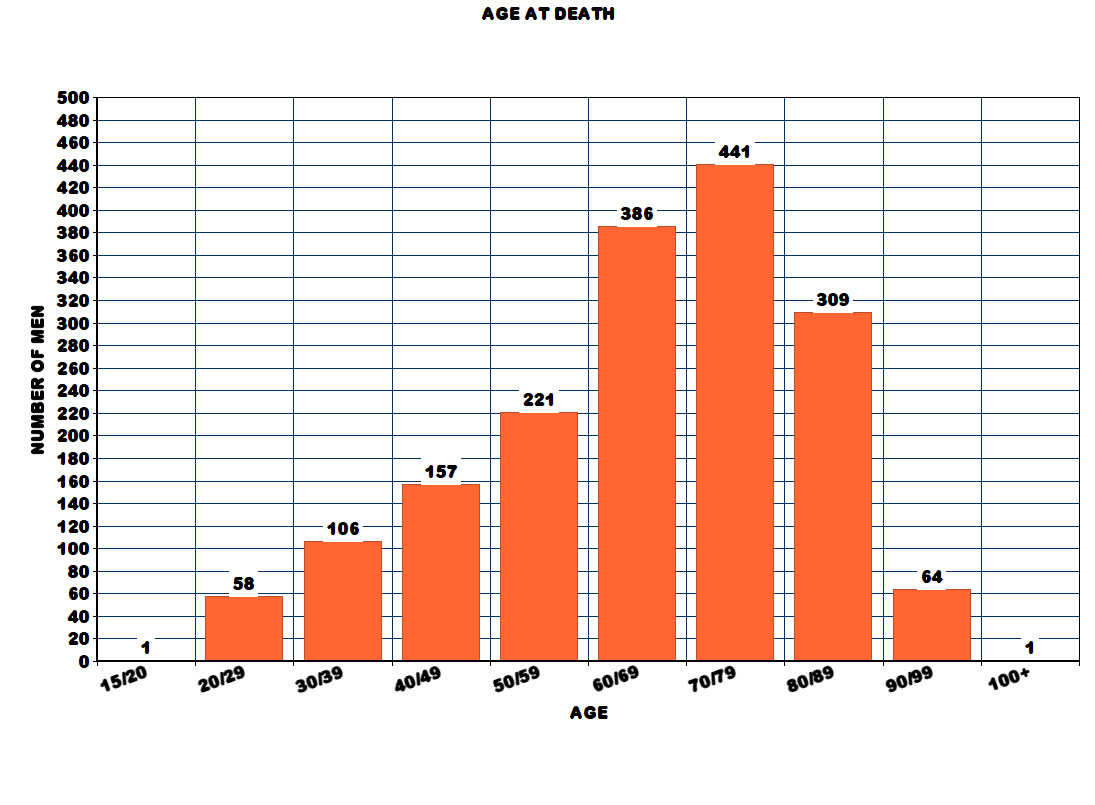
Were they criminals ? Very few had either any criminal record or had been cashiered before they joined the ADRIC, I could only find 4. An initial analysis shows 108 men who served in the ADRIC were convicted of criminal offences after WW1. As I have not been able to get details of men with very common names, this figure would be higher if that could be factored in.
So how did it all start?
Nothing in researching the ADRIC is straight forward. Most of their records were destroyed when they left Ireland, and records that remain are difficult to read, incomplete, and generally not "professionally" kept. There was no complete, searchable record of the men who served. I had to construct that in order to slot the random collection of facts (often rambling, but usually with a semblance of truth) that emerges from Irish newspapers, English newspapers, IRA "Witness Statements", National Archive material, genealogical material, contemporary books. Once I had that list in place, which I do now, then it became easier to place the right information in the right places.
It all began with a Cabinet meeting on 11 May 1920, the Secretary of State for War, Winston Churchill, suggested the formation of a "Special Emergency Gendarmerie, which would become a branch of the Royal Irish Constabulary." Churchill's proposal was referred to a committee chaired by General Sir Neville Macready, Commander-in-Chief of the British forces in Ireland. Macready's committee rejected Churchill's proposal, but it was revived two months later, in July, by Major-General H H Tudor, the Police Adviser to the Dublin Castle administration in Ireland . In a memo dated 6 July 1920, Tudor justified the scheme on the grounds that it would take too long to reinforce the Royal Irish Constabulary with ordinary recruits. Tudor's new "Auxiliary Force" would be temporary: its members would enlist for a year: their pay would be £7 per week (twice what a constable was paid), plus a sergeant's allowances, and would be known as "Temporary Cadets". A 2nd Lt in the Army would have got 16/- a day in comparison. The pay in the ADRIC went up to 21/- a day in late 1920. On top of the pay they got allowances, one months leave a year on full pay, and a return rail warrant. Allowances included rent allowance (11/6d per week for married man), boot allowance 1/6d per week, separation allowance (married men got 2/- per day if separated from their wife), 5/- per week plain clothes allowance - the effect was that a married man got an additional £83-6-0 per year on top of his salary of £546 per year.
Recruiting for the ADRIC began in July 1920 Applicants had their military records and police references checked. This appears to have been conscientiously done, in as much as one finds letters on officers files in The National Archives showing that it had been carried out. There extremely few examples of underage men, or bogus medals. Once a Cadet was then interviewed and approved, recruits were sent twice a week in groups to the depot in Ireland. The majority were recruited in Scotland Yard Headquarters, London by Major Cyril Francis Fleming, County Inspector, RIC and Captain Francis Jackson, District Inspector, RIC.
Command and control of ADRIC companies was somewhat lax. Since company commanders (District Inspector 1st class) were equal in rank to senior RIC district inspectors, they took orders only from county inspectors, divisional commissioners, and their own commandant
The term "officer" applies to men who held the rank of District Inspector (class 1 or 2 or 3). Company Commanders were referred to as "Major" even though their Army rank may have been lower, and the Second in Command of a Company similarly was referred to as "Captain" even if he had only been a Lieutenant. This appears to be engineered so that an ADRIC Company Commander was only out-ranked locally by an RIC County Inspector or a Lt Col. - a fact that gave the ADRIC considerable freedom of manoevre

Originally there was a nominal six-week course on policing at the RIC’s Curragh training centre, the first ADRIC Companies became operational in September 1920. As far as I can ascertain, this six weeks was cut as the ADRIC became established and men went straight to their allotted Company after 4 or 5 days in Dublin. . By September 1920 five companies were operational, each originally with a strength of about 100 to 110 (each with 4 Platoons) and by Dec 1920, the division was 1,145 strong. The rolls of the ADRIC show a total of 2214 men joined over the period of their existence, though for various reasons the total is lower than this, and with men leaving, the maximum strength never got above about 1500 men.
The Auxiliaries were nominally part of the RIC, but actually operated more or less independently in rural areas. Divided into companies (eventually 21 of them), each heavily armed and highly mobile, they operated in ten counties, mostly in the south and west, where Irish Republican Army activity was greatest. They wore either RIC uniforms or their old army uniforms with appropriate police badges, along with distinctive Tam-o-shanter caps.
They were commanded by Brigadier-General F P Crozier - in fact Crozier was in command for a surprising short part of the ADRIC's existence at only 20 weeks (he was in command 27 weeks, but away from duty, injured, for 7 weeks following a car smash during this period). Crozier resigned in Feb 1921, and Brigadier-General E A Wood took over command and ran the Auxiliaries until they were disbanded - Wood was in command therefore 55 weeks - 48 weeks plus the 7 weeks of Crozier's car injury absence.
Originally a Company was about 110 men and had 4 Platoons. In early November the number of Platoons per company was reduced to 3. According to Crozier this was to enable more companies to be put into the field quickly. One can see this changeover from a surviving fragment of strength information , and the reduction to 3 Platoons per Company takes place from 18 Nov 1921.
The monthly ebb and flow of recruits can be followed
| Total arrivals in month | Total departures in month | Strength at end of month | ||
| no date | 12 men | |||
| Jul 1920 | 64 | 0 men | 64 | |
| Aug 1920 | 401 | 13 men | 376 | |
| Sep 1920 | 181 | 19 men | 538 | |
| Oct 1920 | 274 | 32 men | 780 | |
| Nov 1920 | 226 | 67 men | 939 | |
| Dec 1920 | 250 | 47 men | 1142 | |
| Jan 1921 | 222 | 58 men | 1306 | |
| Feb 1921 | 151 | 86 men | 1371 | |
| Mar 1921 | 108 | 63 men | 1416 | |
| Apr 1921 | 46 | 61 men | 1401 | |
| May 1921 | 79 | 44 men | 1436 | |
| Jun 1921 | 84 | 65 men | 1455 | |
| Jul 1921 | 23 | 29 men | 1449 | |
| Aug 1921 | 0 | 46 men | 1403 | |
| Sep 1921 | 1 | 45 men | 1359 | |
| Oct 1921 | 35 | 26 men | 1368 | |
| Nov 1921 | 52 | 29 men | 1391 | |
| Dec 1921 | 11 | 24 men | 1378 | |
| Jan 1922 | 0 | 3 men | 1375 | |
| Feb 1922 | 1 man | 1374 |
In changing from 4 Platoons per Company to 3, 1 Platoon was detached from A, B, C, D, E, F, G, and H Companies
1920 Jul 27. The first recruits started arriving in Dublin. There was no command structure
1920 Aug 10. Crozier wrote that initially the ADRIC organisation was chaotic. They were barracked at The Curragh and recruits had to arrange their own messing and canteens, and there was nobody in command. About 10th August the cadets were formed into 2 companies A and B. Crozier commanded A Coy and Kirkwood commanded B (Kirkwood did not stay long and resigned from ADRIC on 28 Sep 1920)
The first six Companies were A Coy, B Coy, C Coy, D Coy E Coy and F Coy as well as a Depot Company
1920 Sep 1. By now Crozier had been confirmed as commander of the ADRIC, and the depot was moved from the Curragh to Beggars Bush Barracks in Dublin
1920 Oct 13 to 20. G Coy was formed with the first intake of 93
1920 Oct 20. Brig-Gen E A Wood joined and soon after that became 2nd in command. When he was promoted to ADRIC commander in Feb 1921 following Crozier's resignation, Lt-Col F H W Guard became 2nd in command from Company commander of D Coy in Galway
1920 Oct 28 to Nov 8. H Coy formed with first intake of 60
1920 Nov 6. 20 ADRIC and 20 RIC men inspected in London by Lloyd George. ADRIC contingent were under the command of T Mitchel

1920 Nov 8 to 17. I Coy formed with first intake of 88
1920 Nov 19. J Coy formed with first intake of 26, rising ten days later on 29th Nov 1920 to a strength of 73.
Companies were supplied with Crossley tenders to enhance their mobility and their tasks included mounting raids and searches for arms, seditious literature and suspect individuals on their own initiative, or in association with other RIC or military units.
Initially two companies of auxiliaries were stationed in Dublin : F Company in Dublin Castle; and the Division's Depot Company was at Beggars Bush Barracks.
T/Cadet Reynolds who was in the pay of the IRA and later joined the Irish Army, says in this notes that are included in Collins Papers,that of the Auxiliaries "some were very good and about 10% were bad eggs" . I believe that Reynolds was not far from the truth there
1920 Nov Kilmichael Ambush in which 16 T/cadets and 1 T/Constable died. It can be found under all incidents in which the ADRIC were involved with their dates.
1920 Nov 23. Crozier had a serious car accident on his way to Dublin from investigating the problem in Galway with D Coy and then inspecting G Coy in Killaloe. On his way back to Dublin the vehicle he was travelling in crashed, and was in Curragh Hospital for a month. He then moved to a Rest Home in Dublin, and finally returned to duty with the ADRIC towards the end of January 1921after 7 weeks absence from command. Wood was in charge of the ADRIC during Crozier's absence.
1920 Dec 9. In its Supplementary Routine Orders divisional headquarters published the names and numbers of sixty-three temporary cadets and eighteen temporary constables who had been fined over the past couple of months. The most common offence among both temporary cadets and temporary constables was absence without leave.
1920 Dec 11. Dillons Cross Ambush and the Burning of Cork
1920 Dec 11. Tudor wrote to the Times. It should be noted that only 64 of the 2131 who joined the ADRIC, actually became District Inspectors in the RIC

1920 Dec 15. Canon Magner murder by T/C Hart
1921 Jan 22. Sir Harmer Greenwood addresses ADRIC at Beggars Bush Barracks. Crozier was back on duty by now

1921 Feb 9. During a raid in Dublin, F Coy ADRIC arrested two Irishmen, James Murphy and Patrick Kennedy. Their bodies were found in a field in Drumcondra. The two IRA prisoners Patrick Kennedy and James Murphy (both men may have been on the execution squads on Bloody Sunday) in the custody of 'F' company of the Auxiliaries were shot dead with pails on their heads and their bodies found at Clonturk Park, Drumcondra, Dublin. The two prisoners had been taken from the ADRIC guard room at Dublin Castle. The dying James Murphy testified that King had taken them and stated that they were Just going for a drive. Captain King, and two of his men, one Irish, were arrested and put on trial for the Drumcondra Murders. They were acquitted by a court-martial on the 15th April as testimony from a dying man was inadmissible. O'Malley met King in the prison exercise yard, who bemoaned his fate that he was a political scapegoat, taking the blame for the government. King was transferred to Galway city as Coy Commander of D Coy.
1921 Feb 9. Trim Looting incident which led to Crozier resigning
1921 Feb 8. The state of ADRIC was shown in this document from Collins Papers

1921 Feb 19. Crozier was "permitted to Resign" over the reinstatement of the Trim Looters, that he had authorised, and Tudor had rescinded.- note that the original entry was 27 Feb, but has been altered to 19 Feb. EAA Wood took over as Commandant from this date..
1921 Feb 25. Lloyd George’s private opinion on their conduct. In a letter ((House of Lords Record Office, Lloyd George papers, F/19/3/4) to Hamar Greenwood, the Irish chief Secretary, the Prime Minister’s hard line in private contrasted with his public assurances and also linked indiscipline in Ireland with public opinion. I am not at all satisfied of the state of discipline in the Royal Irish Constabulary and its auxiliary force. Accounts reach me from too many and too authoritative quarters to leave any doubt in my mind that the charges of drunkenness, looting and other acts of indiscipline are in too many cases substantially true ... [ This is] causing grave uneasiness in the public mind .. . It is vital that the violence and indiscipline which undoubtedly characterises certain units in the Royal Irish Constabulary should be terminated in the most prompt and drastic manner. It is weakening seriously the hands of the executive.... Public opinion, which is already unhappy, will swing round and withdraw its support from the policy which is now being pursued by the Government in Ireland. There is no doubt that indiscipline, looting and drunkenness in the Royal Irish Constabulary is alienating great numbers of well disposed people in Ireland and throwing them into the arms of Sinn Fein
1920 Apr 30. Viscount French, the departing Viceroy, inspected the RIC at Phoenix Park - 6 Officers and 212 Other Ranks of RIC plus 7 Officers and 125 Cadets of ADRIC . It was his final parade as Viceroy
A later document from Collins Papers, undated, but around mis 1921 gives Company numbers. From Z Coy I think it about 1 Jun 1921

1921 Jul 10. All recruiting for ADRIC suspended and did not resume until Oct 1921
1921 Jul 11 . The "Truce" came into effect between the British and the IRA. Hostilities (mainly) ceased
1921 Oct 10 Inspection by Lord FitzAlan

1921 Oct 25 Recruiting for ADRIC re-commenced, but only 100 men were added before the withdrawal in Jan 1922

1922 Jan 11. FHW Guard posted "to Holyhead", to oversee the demobilisation of ADRIC there. As well as FHW Guard, S Fenner , FJ Richards and AT Barker were posted to Holyhead to control the demobilisation. There were based on the ferry Galtee More, which was moored alongside at Holyhead

Galtee More used on paying off the ADRIC at Holyhead
1922 Jan 16. Withdrawal starts for the ADRIC. Companies came first to Dublin, then by boat to Holyhead, where they were paid off, handed in their weapons, and dispersed to their homes in mufti. Dispersal was not without a frisson of discontent. First in Dublin there was haggling over the terms of cessation of their contracts

Then in Holyhead

And at the end an agreement signed at Dublin Castle , by the Assistant Under Secretary, Cope, representing the Imperial Government, and six members of the Representative Body of the Auxiliary Division, duly accredited for that purpose which gave the Dispersal Terms.
1922 Jan 24 . There were various press reports of the details of ADRIC companies dates of demobilisation. None of them agree, but the movements were something like
1922 Mar 28.

1922 Apr 12. So it was all over in Ireland for the ADRIC, next stop for many of them was Palestine and the Palestine Gendarmerie, with their old boss from Ireland H H Tudor now in charge in Palestine. 750 recruits for Palestine embarked on the Steamer ‘City of Oxford’ at Devonport Dockyard., arriving in Palestine on 29 April 1922. 159 of them were ex-ADRIC Cadets - the link gives their names and Service numbers. This represents about 1 in every 9 Cadets in ADRIC at demobilisation , moving on to Palestine
1922 Mar 6. Hansard. Lieut.-Colonel ARCHER-SHEE asked the Chief Secretary how many members of the Auxiliary Division, Royal Irish Constabulary, sentenced to terms of imprisonment, are still in prison; and whether these men are to be detained, though Sinn Fein prisoners imprisoned for similar offences have been released?. Sir H. GREENWOOD There is only one late member of the Auxiliary Division in prison. This man was convicted after the Truce for having falsified accounts with intent to defraud and for having obtained money by false pretences. He is now undergoing sentence for those offences. He has submitted a memorial which is at the present time under consideration. (This appears to be Joslyn CS gaoled for false accounting in Dec 1921)
At the end of the day one can now pull out various facts
Contact me Details of how you can get hold of me