
HGG Goddard and his wife Susie in 1955
1894 Jan/Mar Born daughter of John and Susan Poole in Glenties, Donegal. A Witness Statement says he was a District Inspector in RIC, however he is not in Herlichy's book of RIC officers, he is in fact a Head Constable in 1901 census at Banagher (equivalent to Station Sergeant)
1901 census Living at Main Street, Banagher, King's Co.

1911 Cenus. Her parents are living in Ballynacarrigy, Westmeath, but she is not there but at College at Carysfort Avenue, Blackrock (it is a Junior Preparatory College)

According to the witness statement she worked on the stage in London from the age of 17
1920 Jan 20. Married in Dublin to Henry Gordan Gerrald Goddard

I am indebted to John Regan for point out this Witness Statement to me. WS 1498
At this time there was a family living in Ballincarrigy named Poole. Mr. Poole had been an Inspector in the R.I.C. from which he was now retired for someyears. His wife and family of two boys and three girls lived with him. They were a very respectable family and very highly thought of by all the people of the town and surrounds.
some pages have been redacted
They ran the Post Office in Ballinacarrigy. One of the girls, Susan, but known to us as Susie Poole, was an outstanding character. I knew the Poole family very well as we were children who played and grew up together. Susie went to the local school and was then sent to a finishing school in some convent. She did not stay too long in this and ran away and came hometo Ballinacarrigy. Susie developed into a beautiful young girl. She had a lovely blonde head of hair and a Venus-like figure. She was very good-looking and had a charming manner and knew how to dress to perfection. After sometime spent in Ballnacarrigy she went away to work on the Stage in Dublin and then to London, I believe as a Chorus Girl. She was much sought after by the men who frequent the theatre stage doors after Shows and amongst whom were always a big percentage of British Armyofficers. While in London she made the acquaintance of a Lieutenant Goddard, afterwards Captain Goddard of His Majesty's Army, whom she married. Captain Goddard was serving, I think, with his Regiment abroad and from hence onwards Susie resided in London and Ballinacarrigy, but mostly in the latter place. Officers from the British garrison in Mullingar visited her in Ballinacarrigy and particularly so from the time they established their outpost at the R.I.C. barracks there. Amongsther officer visitors was a Captain Money who was the Intelligence Officer in Mullingar Barracks, and a Captain Wallace who was Adjutant of that barracks. Captain Wallace was madly in love with Susie (Mrs. Goddard).
I knew Captain Wallace very well and often had tea with him and Susie in her home and he knew that Susie was very friendly with me and had confidence in me. Wallace was a fine type of English gentleman with a very likeable disposition. He seemed to have great power in his appointment in Mullingar Barracks. On one occasion Susie told me that one of the other officers had threatened her with a gun when she would not acquiesce to his advances. She informed Captain Wallace about this and the officer was immediately transferred from Mullingar. One day Susie came to me and told me that Military from Mullingar were going to search the Irishtown area where they had information that the Volunteers had an arms dump. This information was correct as it was there our shotguns and some other weapons were dumped. I immediately had the stuff cleared out of Irishtown and,right enough, the following morning they searched the place. On the lorry with them was Redican who was then a prisoner in Mountjoy. This incident made me perceive that in Susie we had a potential source of information about the enemy. Knowing her love of adventure and other qualities on which I played, I approached Susie and suggested that she should work for us. She agreed to do so on the understanding that I would guarantee the safety of Captain Wallace and Captain Money. I gave this guarantee to her. I had complete confidence in Susie and was satisfied that she would not double cross me. From thence on Susie began to supply me with numerous and useful bits of information about intending British operations, such as places to be raided, rounds-up and men who were on the wanted or suspected lists, all gleaned from the officer friends. On one occasion I was having tea with Susie and Wallace. Wallace told me that Captain Money had said to him that if he continued to visit Ballinacarrigy his dead body should be found on the roadside one morning, and asked me if that could happen. I assured him that such a thing would never happen and he seemed much relieved and thankful.
I realised that in Susie we had an intelligence agent which could be developed an a much higher level than the petty intonation that could be got around Mullingar. Apart from the military side, Mullingar was an important centre for intelligence. Through the Post Office there, passed all messages both in clear and in code for the various military and police stations in the Midlands and West of Ireland. Mick Collins had the source tapped and the two telegraphists there, Mr. Hynes and Mr. Dunne, intercepted all messages of this sort passing through. They made copies of them and were even able to decipher them and pass them out to the Volunteers in clear. There were,however, delays in having this information sent to G.H.Q. and Collins sent down a special Intelligence agent to develop this source. The special agent was the late Harry Conroy who was originally from Sligo. Conroy posed as an insurance agent.
I got in contact with Conroy and told him about Susie and he agreed to meet her, which he did. Conroy went to Dublin as a result of this interview and SAW Collins. I now received instructions to report to Dublin to see Collins, which I did. In Dublin I met Collins and Gearoid O'Sullivan and was put through the mill regarding Susie. Collins told me I was playing with fire but I replied that I had complete trust in her. Collins instructed meto bring Susie to Dublin to see him, which I did, and I introduced her to Collins and Gearoid. From thence on Susie was Collins' pidgeon and I had little or no contact with her. I do not think she knew who Collins or O'Sullivan really were, until after the Truce. Collins got Susie to come to reside in Dublin in a Flat somewhere around Whitworth Road area where she entertained high-ranking Armyand Police Officers of the British Forces, She also travelled extensively throughout the country, but I have no knowledge of what type of work she was doing for Collins
Redacted pages
On one occasion I met Captain Wallace and Susie by appointment in Dublin. Captain Wallace and I had a very frank discussion or debate on Irish and current affairs. Captain Wallace agread with me that the British Empire was fastly declining and that the days of the British Armyin Ireland were numbered. He did not visualise an Irish Republic, but some other form of settlement. in which the British forces would evacuate the country. I was next instructed by Collins to find out if Captain Wallace would agree to meet the late Erskine Childers and if so to fix up a meeting. I was not to let Wallace know who Childers was, but to inform Wallace that a gentleman of high position in the Movement would like to meet him. I contacted Captain Wallace and he agreed to meet the gentleman, and the meeting was fixed to take place on a certain night in Brophill's Hotel, Mullingar. Wallace turned up for the meeting alright, but I got a dispatch from Collins cancelling it just prior to the time arranged. It was coming quite close to the Truce at this time and Collins may have decided not to go on with whatever he had in view, and complicate Captain Wallace at that stage. From time to time messages were being sent by our people in different parts of the country, particularly in the Sligo and Leitrim areas to G.H.Q. reporting that a blonde lady was travelling around with the Auxiliaries in their lorries. This was Susie. Susie's husband either resigned or retired from the British Armyand joined the Auxiliary Force in Ireland, serving in the Sligo area. She told me afterwards that Collins got her to get her husband to come over here and join the Auxies. I don't know what Collins' motive in this would be except perhaps he believed he could use him for intelligence work also. She probably had ideas about marrying Captain Wallace or Mick Collins or God only knows who. I have read Susie's (Mrs. Goddard's) articles published in a certain English Sunday paper regarding her activities on behalf of the I.R.A. and, while I amnot in a position to contradict what appeared, I do think that either she or the publisher were drawing the long how quite a bit. However, I do knowthat she certainly contributed in a big way to bring about the downfall of the British Empire in Ireland and not for any monetary pain as she had ample money for herself. Her husband seemed to keep her well supplied in this respect. She never double crossed us although the temptation to do so must have been great. She had a heart of gold and would help anybody in distress whom she liked and above all it was an Irish heart. I met Captain Goddard after the Truce and he impressed me as a very fine type of man and I would say a very honourable one. I have a brother living in London who often visits Captain and Mrs. Goddard at their residence there and he informs me that they seemto be very happy together with the children and I am very glad that is so.
And another mention in WS1439
Regarding Intelligence, the man who started using Susie Poole (Mrs. Goddard) for intelligence purposes was Mick Murray (he is the writer of WS1498 above) of 451, Collins Avenue, now an agent in the New Ireland Assurance. Company. I think I would be safe in saying that nothing useful in the way of intelligence came from Mullingar post office. The material got from there. had no bearing on the Mullingar Brigade area, although communications captured concerned other areas. The staff in the Mullingar Post Office were Jimmy Hynes, Mick Dunne and Miss Lily Dawson, who were the three principal officials. Mr. Harry Conroy would know more about it, because he was dealing with them. He had been sent by Mick Collins to Mullingar to work up this source of information and to arrange lines of communication for getting it to General Headquarters or to other places concerned. Hynes, who was principal telegraphist, arranged that, when one of them was going off duty, he would taka it to a selected agent. All communications were dealt with directly by Nicholas McCabe who had organised the railway communications from Athlone to Dublin. Jimmy Hynes intercepted the message from Dublin Castle to the police in Mullingar that Seán MacEoin was travelling on the train, leaving Dublin by evening train for Longford, and that he was to be arrested at Mullingar station. Hynes passed this message out to Killeavy, I think it was. That night, I was sitting in a back parlour in a licensed premises in Mullingar, drinking port with Harry Conroy when a messenger came along to Conroy. I don't think Hynes had carried out the message himself, but he sent someone else with it. When he came off duty, the shooting had taken place and MacEoin was arrested. Hynes went to Killeavy and said, "Did you get my message?". Killeavy said, "yes, but I could not get a bicycle", It was only when the messenger came to Conroy that I learned that MacEoin had been arrested and was now also badly wounded.
There was a lady living in Ballynacargy by the name of Mrs. Susie Goddard. Her father and mother owned the post office there. She was married to a Captain Goddard who was serving in the British army while she was a chorus girl on the stage in London. She was a very attractive woman in every way. Harry Conroy and Mick Murray of Ballynacargy had already contacted Mrs. Goddard before I met her. When her husband was demobbed after the war in 1918, he joined the Auxiliaries, came to Ireland and was stationed in Sligo or the west. Mrs. Goddard was living still in Ballynacargy. She wanted to get her husband shot, and wanted the I.R.A.. to do it, and was willing to do anything she could do in return for this favour. At the same time, she was doing a very strong line with Adjutant Wallace of the Mullingar barracks. He used go to see her from time to time in Ballynacargy.
We knew about this, and thought it might prove useful. It did prove useful and she was able to pick up an amount of useful information regarding pending raids and rounds up by the enemy. Conroy told Mick Collins about Mrs. Goddard and what she could do and how she could fit into any position. Arrangements were made, which Murray would know more about, because he went into Mullingar to Brophy's Hotel to meet Erskine Childers. He was either to meet Susie, or bring her there to meet Childers. However, the whole thing was called off because peace overtures were going on, that we knew nothing about, and Childers did not meet her. Collins got Mrs. Goddard to come up to Dublin and interviewed her himself and laid his plans. That was the last we saw of Susie for some time. She had a flat in Dublin and entertained the Auxiliary and other officers of the Castle. Collins met the officers at her flat, being introduced as some lover of Susie's. Susie was "here to-day and gone to-morrow". She would say to me, "Michael Collins is a lovely boy. I love Michael Collins". She would love anyone! When the Truce came, Susie returned to Ballynacargy, and with her came the husband. It was then I met him for the first time.
Mrs. Goddard was useful to us before the Truce. She gave us information she got front Captain Wallace, Adjutant of Mullingar Barracks. if a big round-up was intended, she would pass that information on to us. She was a good-natured, unfortunate girl. I never knew what to make of her. Anything that was impossible was her ambition, and it nearly broke her heart if she did not get it. She thought nothing of. passing on what information she could get. When her husband was demobbed from the Auxiliaries, he went to Palestine to join the police there, it was not for love of money that she did this for us.
1922 Her husband joined the Palestine Gendarmerie and worked in Palestine until 1949.
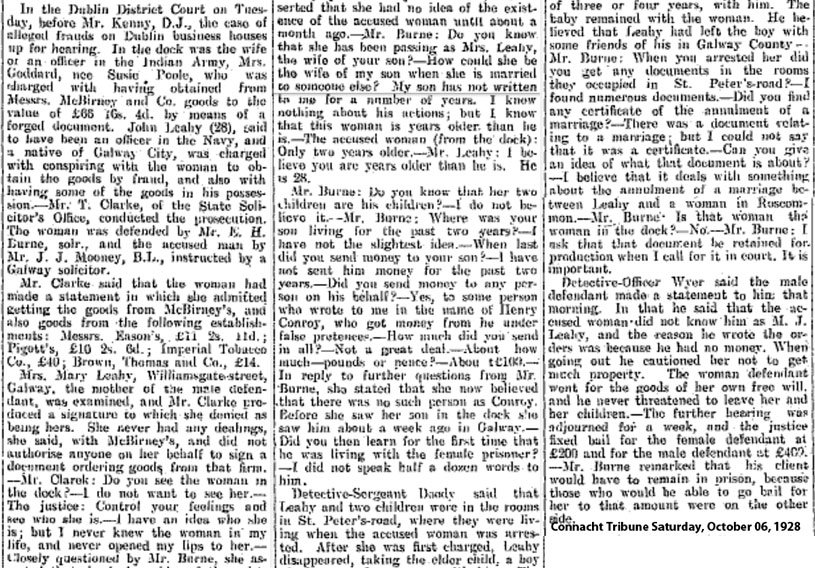
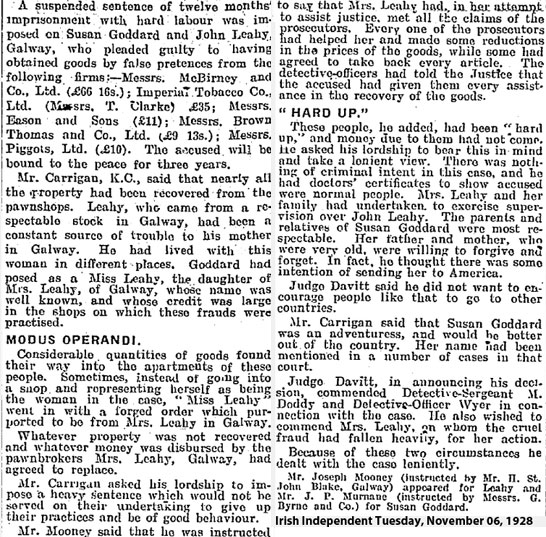
1928 Suspended sentence for fraud. She had been living with a John Leahy (described as 28 years old, from Galway and an ex-British Naval Officer). She has had 2 children by him
1949 He husband retired from Palestine Police.
1955 She returns to Ireland "after 28 years" - implying she left in 1927
