

 |
 |
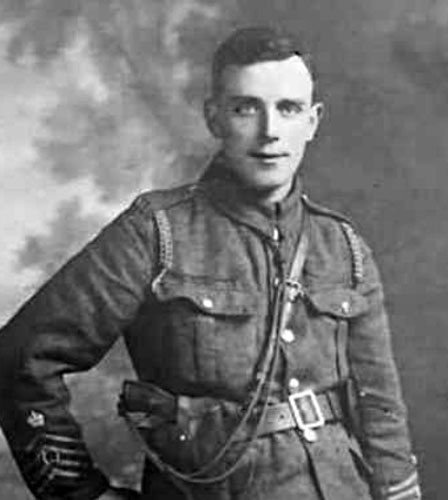
1895 Sep 6 Born Lisnaskea, Fermanagh. Henry James Armstrong was born on 6 September 1895 at Stranafely, Brookeboro, County Fermanagh, the first of at least nine children to farmer Thomas Armstrong and his wife Elizabeth (nee Jones)
1901 census at Stranfeely, Deerpark, Fermanagh

1911 census at Deerpark, Fermanagh

1912 Oct or Nov . He enlisted in the North Irish Horse in October or November 1912 (No.751 – later Corps of Hussars No.71092).
1914 Aug 7. Landed in France. On the outbreak of war he was mobilised and joined A Squadron, embarking for France on 17 August 1914. In the following months the squadron served during the Retreat from Mons and Advance to the Aisne. A letter he wrote home at the time was published in the Belfast News-Letter of 10 December 1914:
WITH THE NORTH IRISH HORSE. Fermanagh Man's Letter from the Front Mr. Harry Armstrong, a former officer in the U.V.F. Force in Brookeborough, writes home an interesting account of his experiences with the North Irish Horse at the front. On the 26th August, he says, they had been doing rearguard for the 4th Division, and had been in action from 3.30 a.m. till 5 p.m., and were almost "done up," having got no rest or sleep for some time previous. That was in the retreat from Mons. "We stopped at a little village to feed our tired horses and to have some food ourselves. Lord Cole rode to the sentry furthest from the village, and returned at full gallop, with the signal 'Mount,' and then we got 'Action rear.'" Handing over their horses (the writer proceeded), they took up a position in the gardens, and opened fire at 1,100 yards, and left many riderless horses in the enemy's ranks. The Germans shelled the village, tumbling over the houses. Hiram Robinson, Brookeborough, and Sergeant Boyd (Maguiresbridge) ran for their horses, when a house which had been struck by a shell crashed down beside them. He saw Sergeant Boyd crawl out from under the fallen house – mud from head to foot – while Hiram Robinson was slightly wounded on the head. Six of them, including Robinson and himself, got detached from their troop, and fell in with the Dragoons, and took part in the charge of the 9th Lancers at Cambrai. "We did three cavalry charges altogether," he adds, "and several bayonet charges with the infantrymen. Nothing puts the Germans to flight like the steel. We charged the infantrymen in the trenches, and with the signal 'Close' we closed knee to knee and cheered our best. Somebody shouted, "Hurrah for Ulster," and somebody else 'No Surrender,' and if you had seen the Germans you would never have forgotten it. They turned as pale as death, and instead of meeting us with fixed bayonets they dropped their rifles with pure fright, and then all was roars and confusion. But we came safe through, anyway. 'No Surrender' for ever."
Later that year A Squadron moved to St Omer, where it remained until January 1916 as escort and bodyguard to the commander-in-chief General French
At some point during the war Armstrong was mentioned in despatches, and rose to the rank of Warrant Officer Class 2.
1918 Oct 30. R Irish Fus. The undermentioned, from Officer Cadet Units, to be 2nd Lts.: — Henry James Armstrong. And posted to the 3rd (Reserve) Battalion, Royal Irish Fusiliers.
1920 Apr 1. The undermentioned relinquish their commns.3rd R. Ir. Fus.—2nd Lt. H. J. Armstrong, and retains the rank of 2nd Lt.
1920 Sep 1. Joined ADRIC with service no 514. E Coy
1921 Mar 18 to 1 Apr on Leave
1921 Jul 15 to 28 Jul on Leave
He was fined £2 by Coy Commander (undated)
1921 Oct 6 to 19 Oct on Leave
1921 Aug 12. Re-engaged
1922 Jan 19 Discharged at demobilisation of ADRIC
1933 Joins Bangor Parks service
1952 Dec 13 Sued fir a £2 debt
1953 May 31 Joined the Home Guard in Bangor (correct address)
1961 Jan 28 Retires after 28 years as Parks Superintendent in Bangor
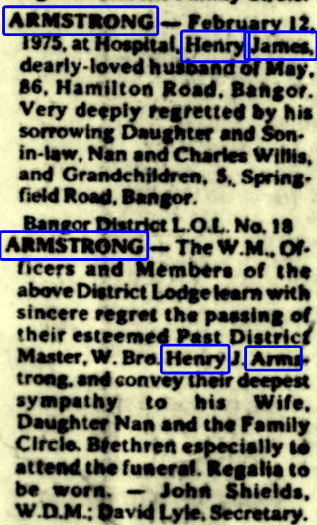
1975 Feb 12 died Bangor, co, Down, Northern Ireland
.
Images provided to North Irish Horse by Roy Suitters.