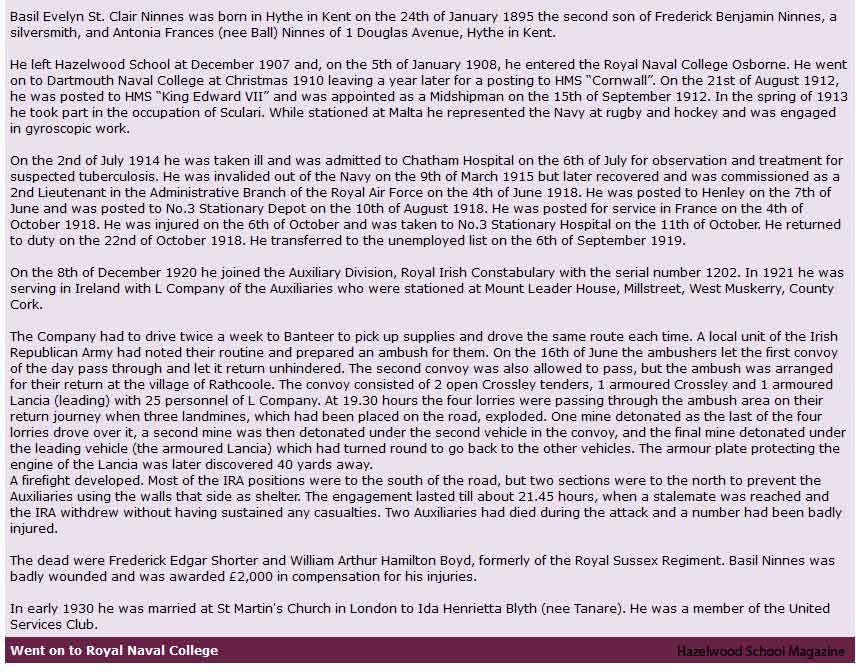
1895 Jan 24 . born Eltham, Kent the second son of Frederick Benjamin Ninnes, a silversmith, and Antonia Frances (nee Ball) Ninnes of 1 Douglas Avenue, Hythe in Kent.
1901 census living with his parents at 1 Douglas Av, St Leonards Hythe, Kent

He left Hazelwood School at December 1907
1908 Jan 5. Joins the Royal Navy at the Royal Naval College Osborne. He went on to Dartmouth Naval College at Christmas 1910 leaving a year later for a posting to HMS “Cornwall”. On the 21st of August 1912, he was posted to HMS “King Edward VII” and was appointed as a Midshipman on the 15th of September 1912. In the spring of 1913 he took part in the occupation of Sculari. While stationed at Malta he represented the Navy at rugby and hockey and was engaged in gyroscopic work.

1911 census. A student Naval cadet at Dartmouth. He appears in RN rolls as a Midshipman RN with only British War Medal and not Victory Medal
He left Dartmouth 1911 for a posting to the armoured cruiser HMS Cornwall which went on a six-month cruise of the Canary Islands, the West Indies and of North America before returning in July 1912. A month later he was posted to HMS King Edward VII, was appointed as a Midshipman in the Royal Navy on 15 September 1912 and was sent to Malta. His naval records show that while he was average at most things, he was regarded as a steady young man who would make a good officer.
1914 Jul 2. He was taken ill and was admitted to Chatham Hospital on the 6th of July for observation and treatment for suspected tuberculosis. He was invalided out of the Navy on the 9th of March 1915 but later recovered and was commissioned as a 2nd Lieutenant in the Administrative Branch of the Royal Air Force on the 4th of June 1918. He was posted to Henley on the 7th of June and was posted to No.3 Stationary Depot on the 10th of August 1918. He was posted for service in France on the 4th of October 1918. He was injured on the 6th of October and was taken to No.3 Stationary Hospital on the 11th of October. He returned to duty on the 22nd of October 1918. He transferred to the unemployed list on the 6th of September 1919.
1918 Jun 7. The undermentioned are granted temp - commns as 2nd Lts. Basil Ninnes
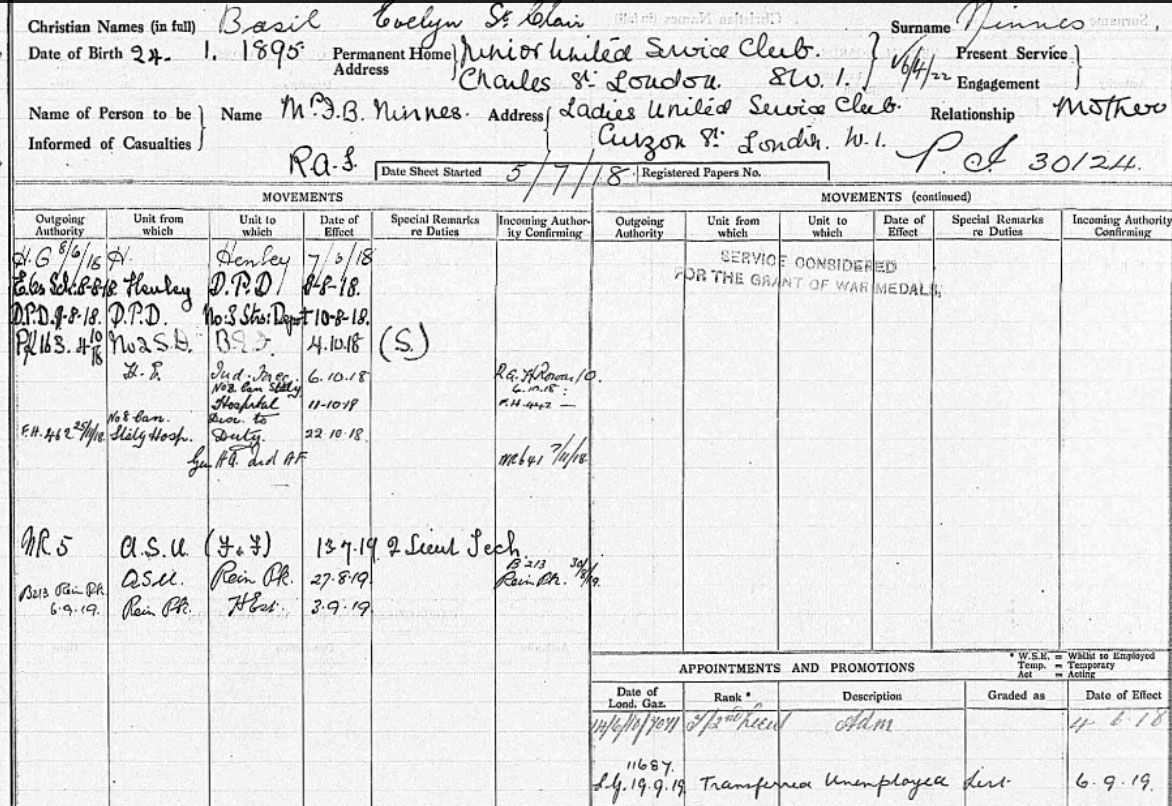
1919 Sep 6. RAF Transferred to unemployed list. Pilot Officer B. Ninnes.
1920 Dec 8 . Joins ADRIC with service no 1202. Posted to L Coy
1921 Jun 16. Injured in Rathcoole Ambush
The Company had to drive twice a week to Banteer to pick up supplies and drove the same route each time. A local unit of the Irish Republican Army had noted their routine and prepared an ambush for them. On the 16th of June the ambushers let the first convoy of the day pass through and let it return unhindered. The second convoy was also allowed to pass, but the ambush was arranged for their return at the village of Rathcoole. The convoy consisted of 2 open Crossley tenders, 1 armoured Crossley and 1 armoured Lancia (leading) with 25 personnel of L Company. At 19.30 hours the four lorries were passing through the ambush area on their return journey when three landmines, which had been placed on the road, exploded. One mine detonated as the last of the four lorries drove over it, a second mine was then detonated under the second vehicle in the convoy, and the final mine detonated under the leading vehicle (the armoured Lancia) which had turned round to go back to the other vehicles. The armour plate protecting the engine of the Lancia was later discovered 40 yards away.
A firefight developed. Most of the IRA positions were to the south of the road, but two sections were to the north to prevent the Auxiliaries using the walls that side as shelter. The engagement lasted till about 21.45 hours, when a stalemate was reached and the IRA withdrew without having sustained any casualties. Two Auxiliaries had died during the attack and a number had been badly injured.
The dead were Frederick Edgar Shorter and William Arthur Hamilton Boyd, formerly of the Royal Sussex Regiment. Basil Ninnes was badly wounded and was awarded £2,000 in compensation for his injuries.
1921 Jul 2 to 24 Aug Medical Leave
1921 Aug 26 Discharged medically unfit due to service in ADRIC
1922 Feb 26. Pension paid for 6 months
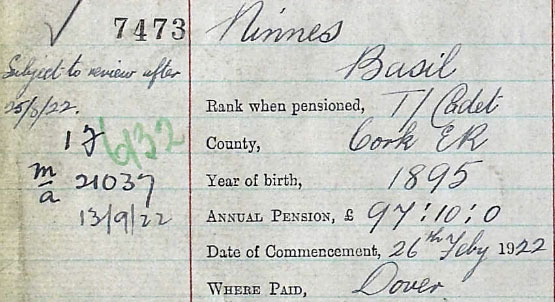
1921 Oct 6. Awarded compensation, the same amount as one of the men actually killed.

He maintained his links with the military, becoming club secretary of the Royal Air Force Club in Piccadilly, despite his very short association and continued to used his military rank of second lieutenant.
1928 he became Secretary of the Folkestone Greyhound Racing Company, which was hoping to take a lease on fourteen acres of land off Danton Road, Cheriton, near Folkestone to build a track, complete with a ‘motor parking ground’. It was to open in 1929 and provide accommodation for ten thousand visitors. Greyhound racing in the area had previously been held at Westenhanger, but was stopped at the outbreak of war. The plan met with some local resistance on the grounds that it encouraged gambling, but in any event, the company seems to have collapsed within a very short time, and greyhound racing did not return to the area until the nineteen forties.
1930 Jan/Mar. Married in St Martins, London to Ida Henrietta Blyth Tanare. Ida was the daughter of a local hotel manager and town councillor, James Tanare, who until his death had run with his wife the Royal Kent Hotel in Sandgate, near Hythe. Now Ida and her mother Sarah ran it together. Basil moved in with them at the hotel, which seems not to have been one of the most up-market outfits in the little town, its advertising being mostly based on its proximity to Shorncliffe camp, the nearby military base. By now, ill-health had forced his resignation as the RAF club’s secretary, and it was at the Royal Kent Hotel that he died
1933 Apr 7. Died. It would appear that his mother did not approve of his marriage from the death notice.
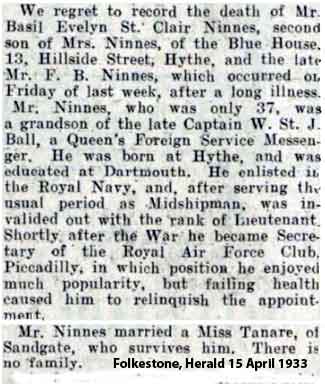

1933 Apr 7. Probate granted to his widow Ida
